In the Slow Magic of Making…
There’s a particular kind of pace in the studio lately that doesn’t translate well to the outside world. It doesn’t announce progress in clear Instagramable milestones. It doesn’t reward urgency. It doesn’t even seem especially concerned with time.
It moves the way something living moves—incrementally, quietly, often invisibly—until one day you realize it has become something undeniable.
I’ve been working on a new series of larger pieces inspired by light and circles, and alongside that, exploring techniques that feel less like something I’ve mastered and more like something I’m in conversation with. Sometimes the conversation involves hours and hours of testing out a technique only to realize that it’s not really working the way I thought and it’s better to undo it, or start over.
There’s a part of my mind that resists this. Is it a waste of time?!?
My mind wants efficiency. It wants resolution. It wants to know where this is going and how long it will take to get there. But the work itself asks for something entirely different.
It asks for listening.
Not listening in the casual sense, but a deeper, more attentive state—where decisions aren’t imposed, but received. Where the next step isn’t forced into place, but revealed through presence and patience.
This kind of listening has its own tempo. And that tempo is SLOW.
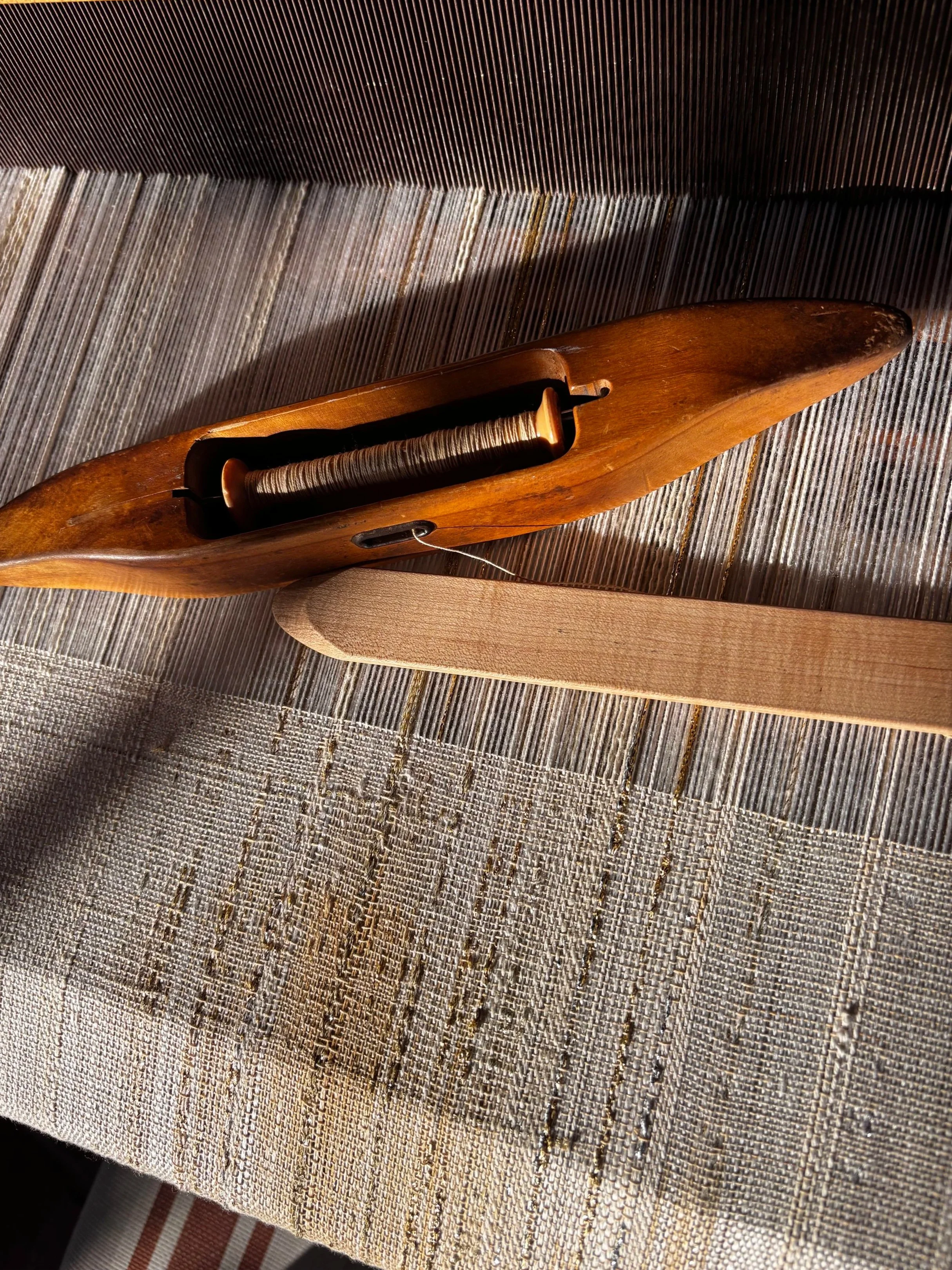
“Bringing in the Light” on the loom
In a world that tends to measure value by speed and output, slowness can feel almost like a kind of defiance. Or even failure. But in the studio, I’ve come to see it as a form of devotion. A willingness to stay with something long enough for it to fully become what it is.
Handwoven work makes this impossible to ignore.
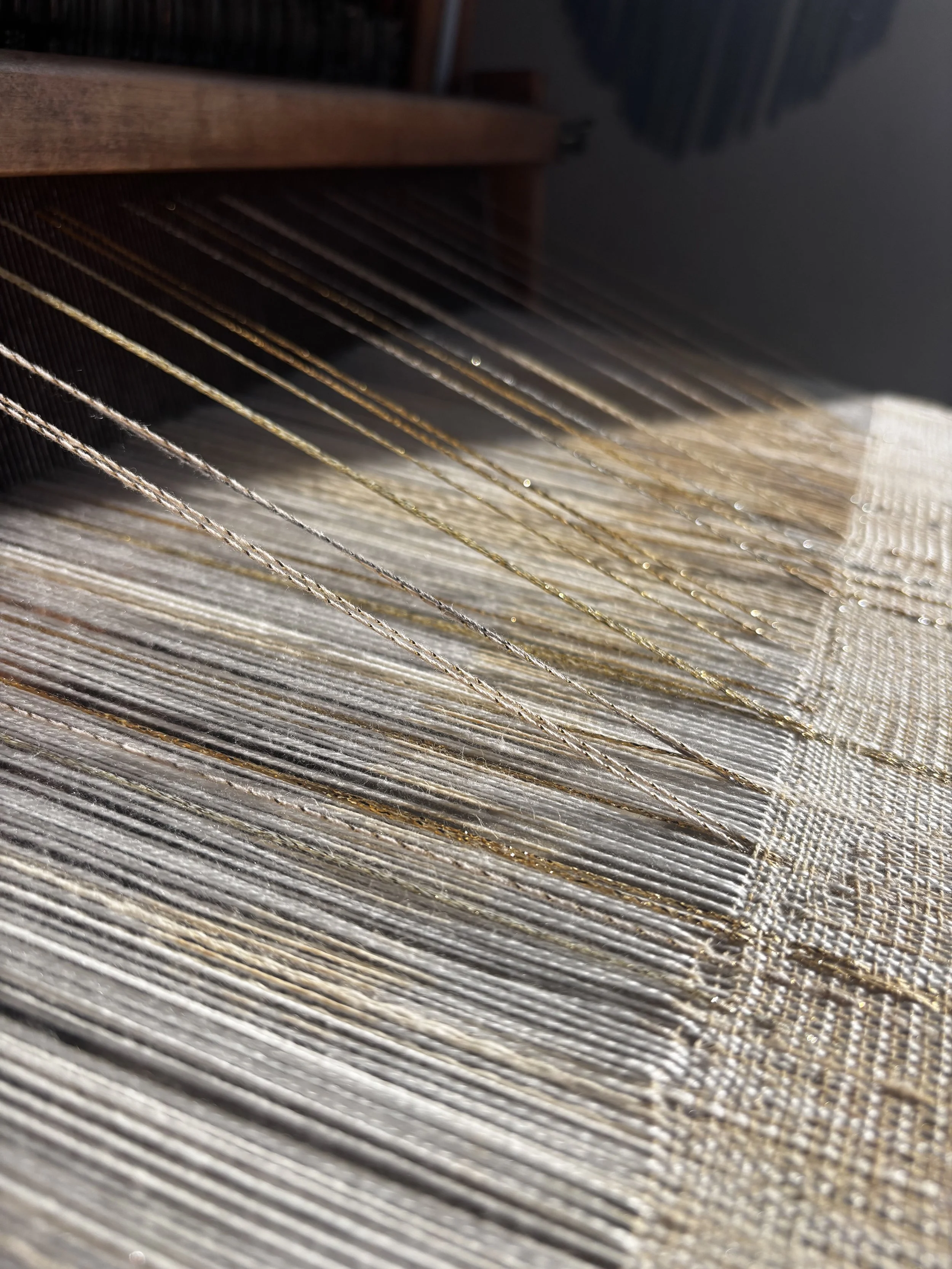
Every inch is earned. Every decision is embedded. There are no shortcuts. In working this way the very structure of the piece becomes alive with the memory of all the decisions that shaped it through the forces of fate, synchronicity, as well as trial and error.
I begin with an idea. A geometric structure, a conceptual thread, a direction. But as the work progresses, it often asks to become something else. Colors shift. Patterns evolve. The original plan loosens its grip.
This is where the listening deepens.
Because continuing to impose the original idea would be easier. More efficient. More predictable. Definitely more profitable as well.
But it would also be less alive.
So the process becomes a kind of relationship—between intention and surrender, structure and emergence. And the role of the artist is not to control that relationship, but to stay present within it.
To notice.
To respond.
To trust.
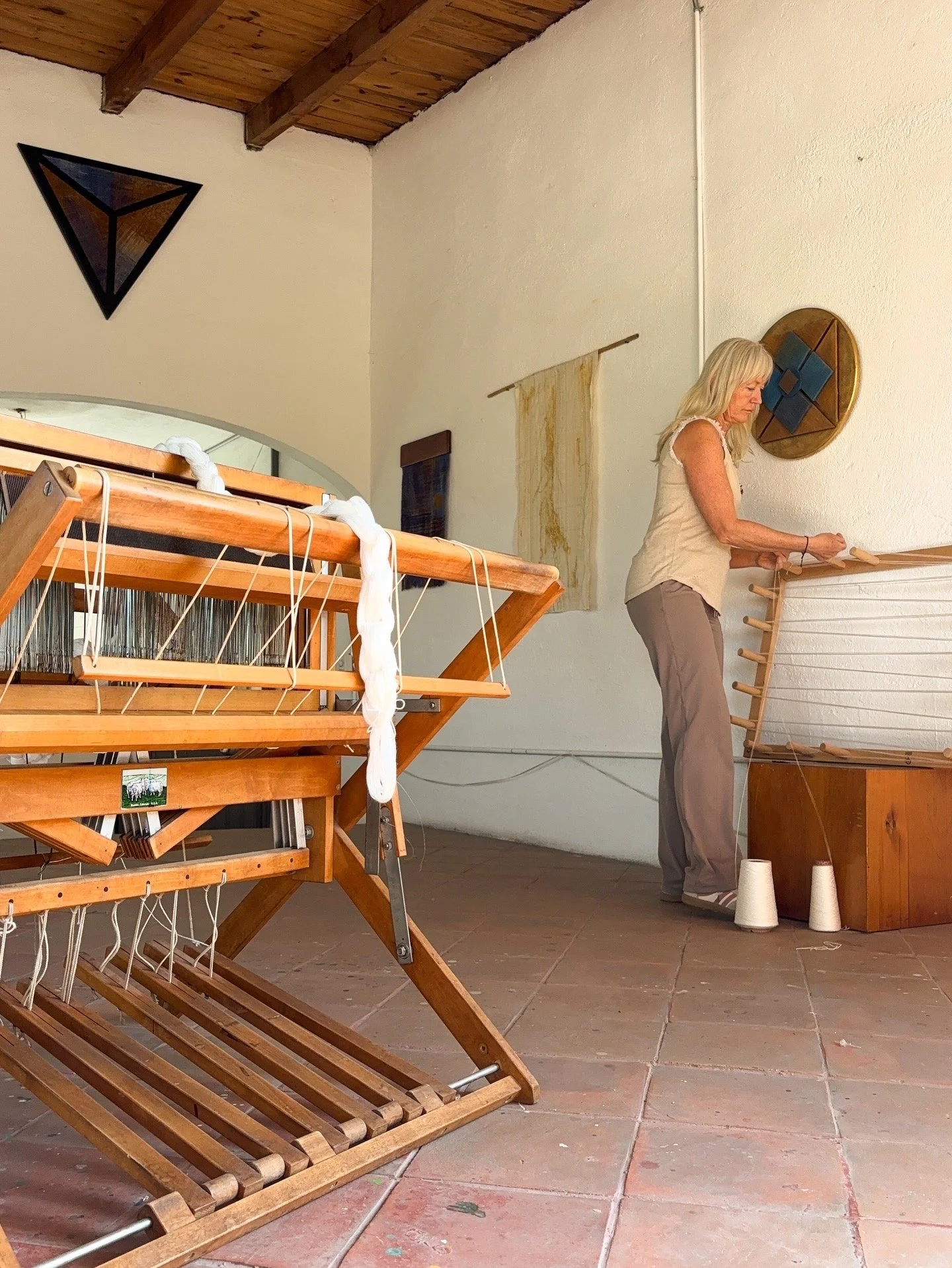
in the studio
This is not always comfortable. Often it’s downright terrifying, annoying and anxiety producing. Slowness reveals doubt just as easily as it reveals clarity. It asks you to sit inside the unknown without rushing to resolve it. One more than one occasion I left the studio after a whole day’s work nearly in tears because I suddenly doubted whether I was even on the right path. Sometimes being an artist is not for the faint of heart.
But having the courage to sit in unknowing and discomfort also opens a different kind of space—one where the work can carry more depth, more nuance, more presence than something arrived at quickly.
Larger pieces seem to amplify this. They hold more time, more decisions, more opportunities for the unexpected to enter. They require a steadiness of attention that feels, at times, almost meditative.
And perhaps that’s part of what draws me to them now. Not just the scale of the finished work, but the scale of attention they require to bring into being.